



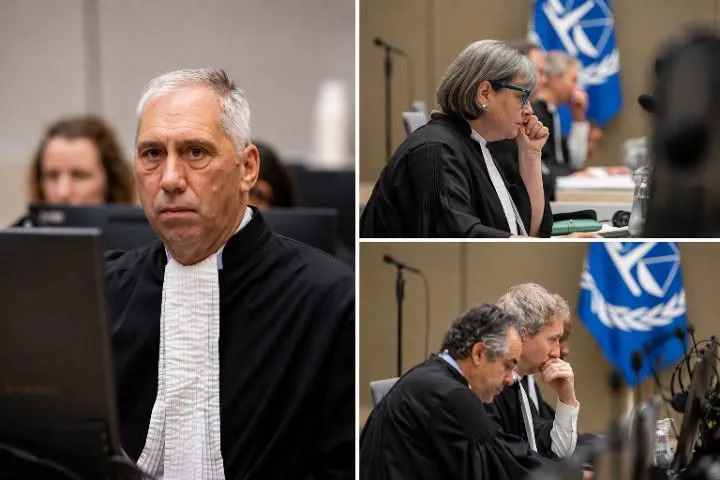
Duterte at ICC: Last status conference discusses witnesses, evidences; 150 hours for prosecution to lay down case as trial starts Nov. 30
Courtesy ICC-CPI
THE HAGUE, Netherlands — Judges and parties at the International Criminal Court (ICC) used the fifth status conference in the case against former Philippine President Rodrigo Duterte to finalize preparations for trial proceedings, address witness management, evidentiary procedures, scheduling, and protective measures intended to ensure the smooth conduct of the upcoming trial.
The trial is scheduled to commence on November 30 until December 18, 2026. It will resume after the Christmas break until the Spring break of 2027.
Once the trial begins, Duterte will be expected to attend every day. The former president waived his appearance in today's status conference.
The last status conference was also marked with several private sessions, where the public watching from the gallery, were blocked audio access. The second session started with only five minutes of public session, then went on private session for the next 25 minutes until the meeting ended.
Witnesses from different time zones
One of the key issues raised during the conference was the scheduling of hearings, particularly for witnesses expected to testify through audio-visual links from different time zones.
Trial Chamber III Presiding Judge Joanna Korner acknowledged that previously proposed schedules would not work for remote witnesses and indicated that earlier start times would be necessary.
"It's quite clear ... that the schedule we set out for the first thing is not going to work when we've got AVL (audio-visual link witnesses), she said.
The Chamber outlined a revised sitting schedule aimed at balancing courtroom efficiency and practical considerations related to witness participation and the accused's attendance.
Hearings will run from 10am to 4pm, Hague time, with a break after every hour, to accommodate medical experts’ advice regarding Duterte.
Prosecution given 150 hours for evidence
The Chamber also addressed the amount of time to be allocated for the prosecution's case.
After reviewing witness statements and proposed testimony, the judges granted the prosecution 150 hours to present its evidence. Based on the agreed schedule, only four hours are allocated per trial day.
The Chamber emphasized that prosecutors would have discretion in how they use the allotted time and would not be restricted to fixed time limits for individual witnesses
Additional witness applications requested
Prosecutors informed the judges that more witness-related applications are expected before trial.
"We will be filing seven additional Rule 68.3 applications ... by the end of this month," according to the prosecution.
Rule 68 procedures allow previously recorded witness statements to be admitted into evidence under specific conditions.
Defense seeks coordination of expert witnesses
Defense counsel Peter Haynes requested that prosecution and defense expert witnesses be heard in close succession to help judges compare competing analyses.
The defense noted that it had retained experts whose fields mirror those of prosecution experts, including statistics and policing.
"We've instructed a statistician and we've instructed a policing expert, said Haynes.
The Chamber expressed support for the proposal. Judge Korner also encouraged experts from opposing sides to confer beforehand and identify points of agreement and disagreement before appearing in court.
Request for Tagalog opening rejected
Lead counsel for the Common Legal Representatives for Victims (CLRV) Paolina Massida asked permission to use portions of Tagalog during their opening statement, explaining that they intended to quote directly from victims' accounts.
"Our request is more during the opening statement. We will make some remarks in quoting parts of a narrative that victims provided to us," she asked.
The Chamber denied the request and ruled that proceedings should continue in the ICC's working languages, English and French, while noting that translated materials would be available.
Korner said that allowing additional trial languages could create complications and additional costs.
Meanwhile, Kristina Conti, co-counsel representing the victims, who was seated at the gallery today, said it was important to convey the message of the witnesses in Filipino.
"Gusto nila na may babasahin na statement diretso, directly from the victims... Mukhang hindi uubra at ang mangyayari ay kung merong sasabihin na statement ng victim, kailangan in English na o translated na."
She added there is no implication on the case whether the language is Filipino or English but it matters for the victims and their families.
"Kung guilty...guilty, whether in English or Tagalog...Pero yung impression lang sa Pilipinas, yung participation ng victims. Isinali nyo na nga kami, may participating victims na tinanggap at tatanggapin pa may mga nag-a-apply. Pero kailangan pala English yung dito. Isa siyang malaking barrier. Lalo na sa iba na hindi naman naaabot kaagad ng CLRV o kaya nakakapag-consult agad sa mga abogado," she added.
Some of the victims families will be in The Hague for the full trial. Their trip is being arranged through their lawyers and by the organisations and church groups that support them, according to Conti.
Icai Enriquez, convenor or the Duterte Panagutin-Netherlands said their group is preparing to assist the families who are coming to The Hague.
"There are rights groups, there are activist groups, there are church groups, there are also just individual groups who are supporting the victims' families....There are ways to find funding, there are ways to find support and finance to help," Enriquez said.
Enriquez also mentioned that the victims families should feel that they are not alone when they are here.
Witness protection remains a priority
Judges and parties also discussed protective measures for witnesses, particularly those expected to testify remotely or under confidentiality arrangements.
The Chamber indicated that more concrete deadlines would be needed to address applications related to witness protection and procedural safeguards before testimony begins.
With the trial date approaching, the Chamber has signaled that the remaining procedural matters can largely be handled through written submissions and email exchanges before the opening of proceedings on 30 November.
Accountability extends to "Bato" and others
The Panagutin Network, meanwhile, noted that the accountability should not end with the former president.
"The pursuit of justice cannot stop with Rodrigo Duterte... The ICC today has reminded Duterte that he must attend trial. We eagerly await to see Duterte’s presence before the judges and answer for his indefensible crimes against the Filipino people. ..We also await the arrest of his former police chief and co-perpetrator (senator) Bato Dela Rosa,” said Fiona Magallanes of Bagong Alyansang Makabayan (BAYAN) Netherlands, adding that the senator is one of the principal architects and implementers of the so-called “war on drugs."


