



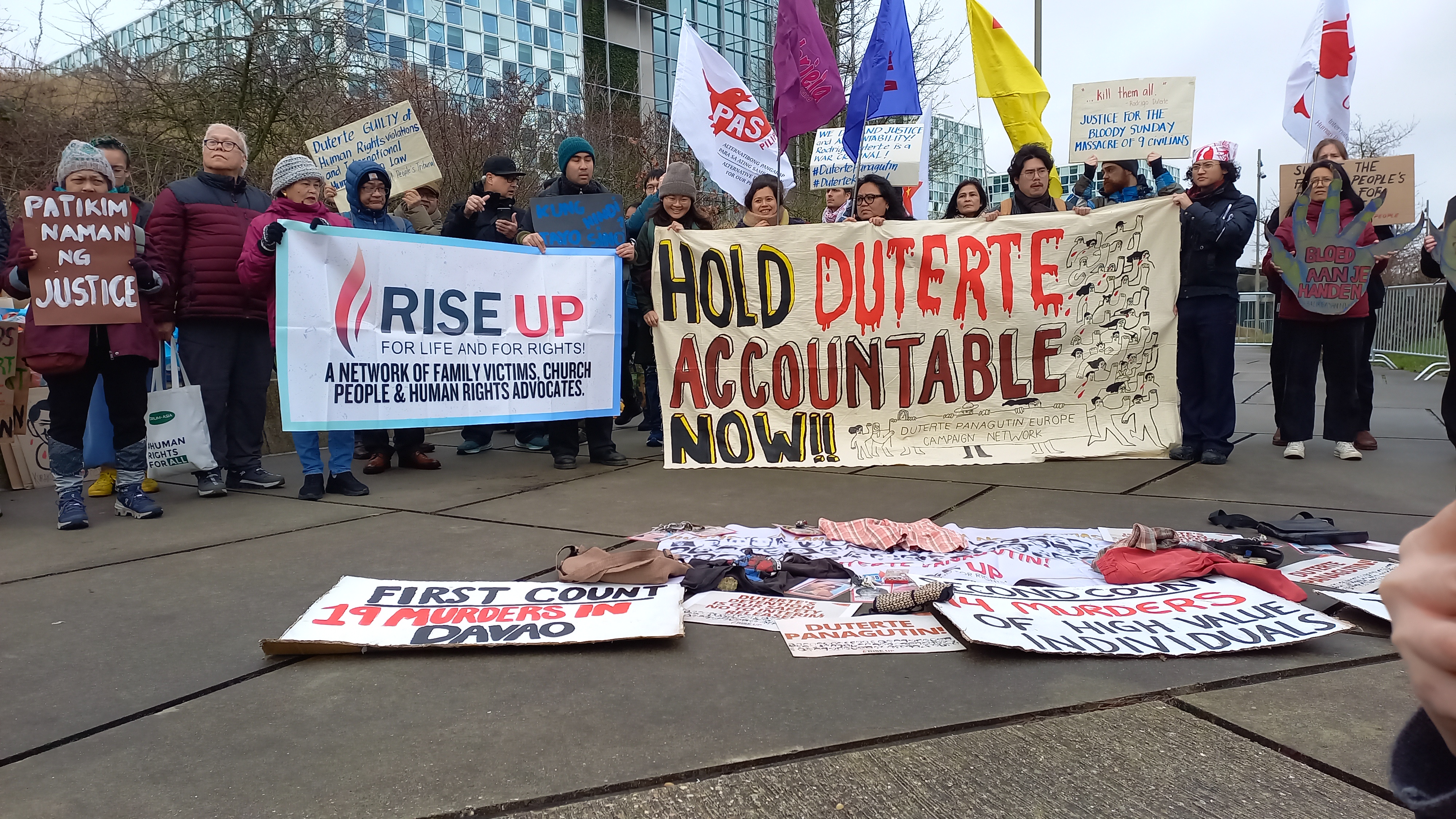
Duterte defence says local courts venue for alleged killings, not ICC; human rights groups decry defence’s false claims
THE HAGUE — Five days before the opening of the full trial against former Philippine president Rodrigo Duterte on crimes against humanity at the International Criminal Court (ICC), his defence team has assailed the prosecution’s allegations that the deaths resulting from his drug war campaign constitute crimes against humanity.
In a 77-page pre-trial filing dated Nov. 25, 2026, The defence, through British barrister and lead counsel Peter Haynes, argued that the prosecution against Duterte is “fundamentally flawed” because it fails to establish the essential legal elements of crimes against humanity under Article 7 of the Rome Statute.
Duterte stands accused as a co-conspirator for three charges of the Crimes Against Humanity Through Murders and Frustrated Murders related to his brutal drug war while he was mayor of Davao City and as president of the Philippines. The crimes being investigated happened between Nov. 1, 2011 and March 16, 2019, the period when the Philippines was still a state-party to the Rome Statute, the governing treaty establishing the ICC. His trial will start on Nov. 30, 2026.
The defence’s filing contended that there was no widespread or systematic attack directed against the civilian population, no state or organisational policy to commit such an attack, and insufficient evidence linking Duterte to the alleged crimes.
They told Trial Chamber III that it “is not contesting the existence of unlawful killings by police” during Duterte’s drug war, but argued the killings “undoubtedly occurred”, but “they were not crimes against humanity."
Haynes said it was arguable for a popularly elected leader to wage an attack against the civilian population.
"...the Prosecution’s case is that a democratically-elected leader was waging an attack against the very people who repeatedly elected him, and who continue to support him to this day," the defence also said of Duterte.
“The link between Mr. Duterte and the alleged crimes are untenable," the defense added.
The defense also claimed that the "the Prosecution places weight on the speeches of Mr. Duterte, but that rhetoric, situated in its proper context, establishes neither criminal intent nor the requisite nexus to the charges.”
They also pointed out, as they have already argued during the pre-trial stage, that the term “neutralisation” did not mean to kill a suspect, opposing the prosecution’s argument before the ICC that “neutralisation” was meant to kill.
The prosecution alleged that from Davao City to communities across the Philippines, an organised campaign killed dozens of people named in the so-called drug watch list and thousands more in the broader anti-drug war. During this period, they claimed, a system emerged in Davao that relied on so-called “neutralisation” of alleged criminals through extrajudicial violence.
In response to the defense's latest filing, the Human Rights Watch (HRW) through its Southeast Asia Researcher Lian Buan said: “Let us remember that there is a nationwide PNP (Philippine National Police) memorandum circular that instructed cops to “neutralize” drug suspects. ‘Neutralize’ has no legal meaning. It became a euphemism to kill, and there’s evidence of police officials acting under this circular of killing unarmed suspects, and then planting evidence to justify the kill.”
Working local courts? For whom?
Lead defense lawyer Haynes also argued that the drug war killings “have been prosecuted and continue to be prosecuted as ordinary murders” in the Philippines, which he said has a “functioning criminal justice system” as well as “functioning domestic mechanisms for accountability – including criminal accountability."
HRW’s Buan was quick to rebut, saying this claim is false and inaccurate.
“Justice is stalled in the Philippines. Let the numbers speak for itself: only five (5) cases have resulted in convictions since 2016. President Marcos’ government vowed to investigate the cases, but since 2024 when the DOJ (Department of Justice) created the task force, it has only filed four (4) cases in court. Victims are facing significant barriers to pursue a case, often the burden falls on them to find the evidence. If you ask victims of the drug war who are willing to pursue charges, they’d tell you they have lost hope here, and have turned their hopes on the ICC,” Buan said through a message sent to TFCN.
Meanwhile, the newly-formed Philippine Truth Commission, an independent, civilian-led institution established to uncover and preserve the truth by centering victims’ and survivors’ voices, said that the defence’s claims are “as bogus as the drug war.”
“The claim that the justice system in the Philippines is working and hence there's no need for an ICC investigation is just as bogus as the drug war. It is a lie.They are saying that in order to defend Mr. Duterte, but it's farthest from the truth. The proof of this is the fact that out of the thousands and thousands of cases, we now have 6,252 cases from the police, 8,320 from the Truth Commission, and maybe even more according to the estimates of human rights groups. Of those thousands of cases, only five cases have resulted in a conviction of police officers,” said Carlos Conde, commissioner at the Truth Commission.
He added that the local courts do not work, especially for the families of the victims who do not have the resources and are facing a blank wall if they pursue justice because the police and other government actors are allegedly complicit in the drug war.
“How can you call that system working with such a dismal record of conviction? Add to that the fact that a huge, huge majority of the cases have not been investigated properly by the authorities. According to Dr. (Rachel) Fortun (forensics expert and commissioner of the Truth Commission), the police doesn't have a death investigation system. In other words, it is not investigated, every single murder is a drug war. So how can they say that the court is working? Also, the fact is, a lot of these victims are from the poor communities. They don't have access to justice. They can't even pay for lawyers.” Conde added.
Conde explained that some of the victims' families are the ones that are coming up with resources to try to get the documents that they need for their cases. “Even with things like police reports and certificates, they have to spend their own money to get those documents, basic government documents. Because the government, the law enforcement agencies do not help them.”
The local courts, Conde maintained, are dysfunctional and broken, serving only the rich ones. “But those who suffer from those defects are mostly the poor Filipinos, not the rich ones. If you are rich in the Philippines, you can get away with a lot of things. If you are rich in the Philippines, the justice system will work for you. But for the poor, that's another story.”
Duterte’s alleged “cognitive impairment”
Besides the defence’s claim that the Hague-based ICC is not the forum to try Duterte, they also said that Duterte is suffering from “cognitive impairment.”
“The 81-year old man, whose cognitive impairment has been acknowledged by court-appointed doctors, one of whom was transparent that Mr Duterte doesn’t remember things from one meeting to the next,” defence lawyer Haynes stated.
“Mr Duterte’s cognitive impairment prevents him from providing Counsel with meaningful instructions,” while “his ability to contribute to his defence is virtually non-existent,’ he added.
The Defence argued these limitations create significant obstacles to preparing an effective defence in a case involving more than 62,000 evidentiary items.
Fit to stand trial
Claims of Duterte's unfitness to stand trial as a result of “cognitive impairment in multiple domains” were raised earlier by the defence during pre-trial. Following the experts’ assessments and the parties’ observations, on January 26, 2026, the Pre-trial Chamber ruled that Duterte is fit to take part in the pre‑trial proceedings, and adopted practical measures to facilitate his participation, including shorter hearing sessions and regular breaks.
On May 25, 2026, the defence requested a new medical examination for the trial phase. During the Status Conference held on May 27, 2026, Trial Chamber III decided that the same three experts who previously examined Duterte will conduct an updated assessment of his fitness to stand trial.
In a Sept. 28, 2026 decision, the Trial Chamber III decided Duterte is fit to stand trial.
It was satisfied that Duterte is able to effectively exercise his fair trial rights. Its decision was based on the findings of an independent Panel of Experts, as well as submissions from the parties and participants in the case.
The Expert Panel unanimously found that Duterte has the capacity to understand the charges against him, the purpose and consequences of the proceedings, and the course of the trial, including the nature and implications of entering a plea.
The panel also found that he is able to understand the evidence and instruct his counsel in the preparation and conduct of his defence. The Chamber also adopted measures to facilitate Duterte’s participation in the trial.
What to be expected during the trial period
At trial, the Judges examine all the arguments and evidence presented in the case by the parties and participants (victims through their legal representatives) to decide whether the accused Duterte is guilty or not of the crimes charged.
The ICC outreach office explained the process.
The trial begins with opening statements and ends with closing arguments, after which the judges deliberate and deliver a judgment. The accused is either acquitted or convicted and, if convicted, sentenced.
Victims also participate in proceedings through the Common Legal Representatives for Victims (CLRVs). The CLRVs are mandated to share victims’ views and concerns, make statements at the beginning and end of the trial, and submit written and oral observations on issues that affect their personal interests.
Victims can also request reparations for the harm they suffered. At the end of the trial, if the accused person is convicted, the reparations stage will start and the Judges will issue a Reparations Order.


