



EDJOP Invites Barcelona Audiences to Reflect on a Chapter of Philippine History
BARCELONA, Spain — It took five years, 19 shooting days and the support of private individuals to bring EDJOP to the big screen. Now, its filmmakers face another challenge: getting younger Filipinos to watch it and learn about a part of Philippine history many barely know.
The film tells the story of Edgar “Edjop” Jopson, a prominent Filipino student leader who became an activist during the Marcos dictatorship and joined the underground resistance against Martial Law. His political involvement eventually cost him his life, leaving behind a family whose experiences are also explored in the film.
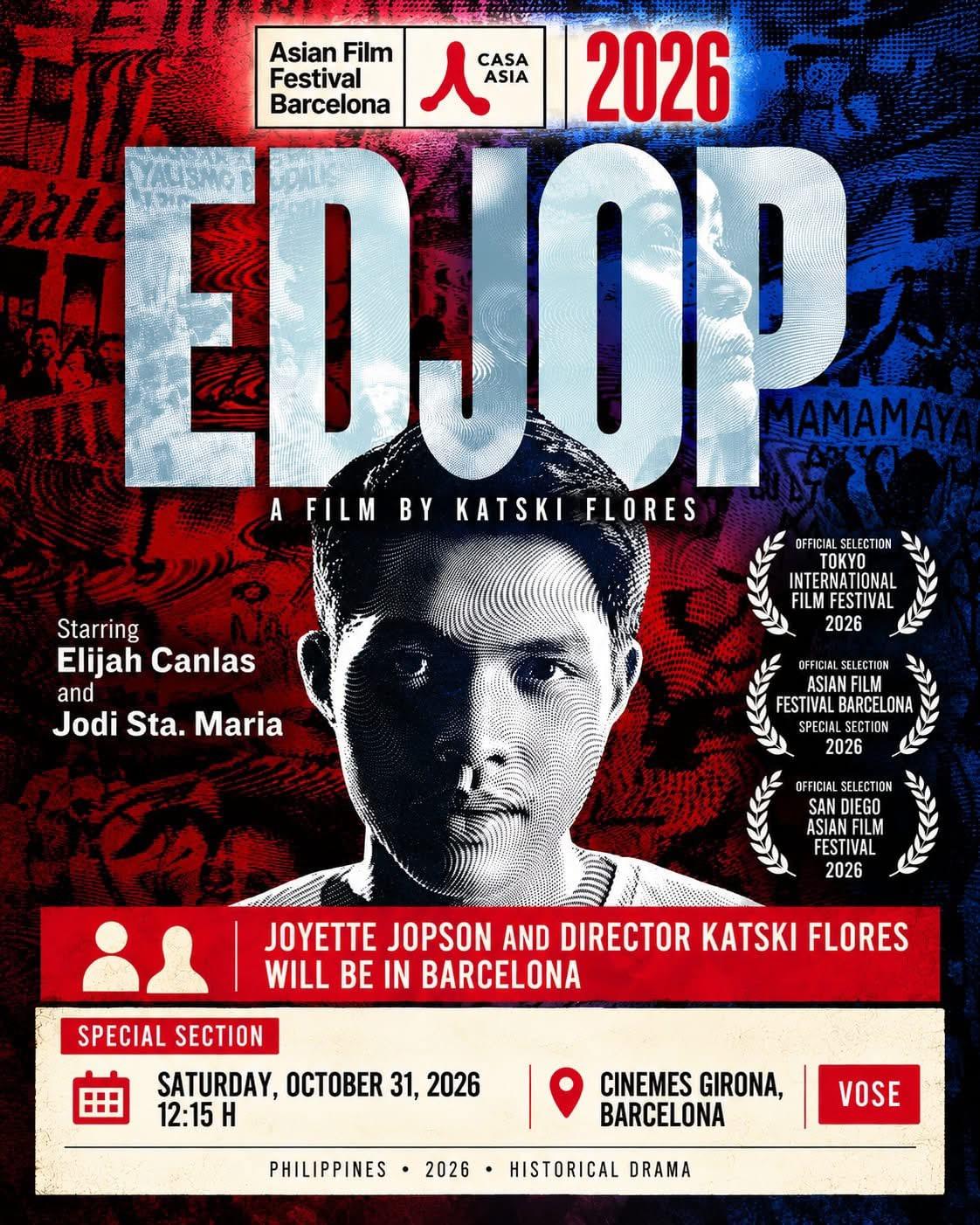
EDJOP was screened at Cinemes Girona on October 31 as part of the Special Section of the 14th Asian Film Festival Barcelona (AFFBCN), with several members of the Filipino community attending to show their support. Jopson's daughters, Joyette and Teresa, were also present and answered questions from the audience following the screening.
Director Katski Flores, who arrived late after being delayed at the airport and missed the Q&A, later spoke with The Filipino Correspondent Network (TFCN) about the challenges of making the film and her hopes of reaching more Filipinos.
Flores said that one of the main reasons for making EDJOP was to raise awareness among Gen Z and younger audiences, many of whom, she believes, know little about Martial Law and rely heavily on social media for information.
“We say that this is a love letter to the Filipinos,” she told TFCN.
Flores explained that, just as a letter needs to be opened and read, the film needs to be watched for its message to reach people. For her, international festival participation is welcome, but reaching Filipino audiences remains the priority.
Funding difficulties repeatedly interrupted production, with Flores and Joyette working to secure support from private individuals and investors who believed in the project. Both served as executive producers of the film.
The film stars Elijah Canlas as Edgar Jopson and Jodi Sta. Maria as his daughter Joyette. Rather than telling a conventional political biography, Flores chose to combine Jopson's life as an activist with his daughter's present-day experiences, connecting the past with the present and making the story more relevant to younger audiences.
During the Q&A in Barcelona, Joyette shared how she struggled for years to understand her father's choices and the sacrifice he made.
“I was told that he died for the good of the country. But I also felt that I got the bad end of the deal, because my country wasn't any better,” she shared.
She admitted that, for years, she had little interest in honoring her father publicly, remembering the birthdays and graduations he had missed.
However, the possibility of telling his story through film eventually appealed to her. What began as an idea in 2019 became a five-year journey that she described as both therapeutic and healing, helping her come to terms with his death and legacy.
Her sister Teresa also answered questions about Martial Law and human rights violations, emphasizing that these should not be measured only by the number of killings, but also by the loss of freedoms and the culture of fear.
Asked what message she hoped audiences in Barcelona would take away from the film, Joyette said it was about hope and how each person could make a difference.
“We don't have to choose the path that he took,” she said, encouraging people to consider what they could do to make their own communities and country better.
Flores said they are planning a nationwide campus screening tour in the Philippines in 2027, following encouraging discussions with students.
More screenings in Barcelona are also being considered to reach a wider audience, particularly young Filipinos who missed the festival screening.


