



Philippine Media Trust Suffers Steepest Drop Globally as Audiences Pivot to Social Video — Reuters Institute 2026 Report
MANILA — Public trust in the media within the Philippines has suffered its sharpest drop on record, according to the Reuters Institute Digital News Report 2026.
The annual study, published on 16 June 2026 by the Reuters Institute for the Study of Journalism at the University of Oxford, revealed that trust in news amongst Filipinos plummeted by 10 percentage points over the past year. Only 28% of adult respondents stated they trust most news most of the time, down from 38% in 2025.
This represents the steepest decline recorded among all 48 global markets surveyed, pulling the Philippines well below the global trust average of 37%.
Researchers attributed the sharp downturn to escalating political polarization, institutional pressures, and direct online attacks against journalists and news outlets. The erosion of trust is particularly severe among vulnerable demographics: only 23% of low-income respondents and 21% of individuals with lower formal education levels expressed trust in mainstream reporting.
The collapse in credibility coincides with a significant, long-term shift in how Filipinos consume information, as audience engagement with traditional media platforms reaches historic lows.
Interest in news has waned substantially, with citizens identifying as "extremely or very interested" dropping to 43% this year, compared to 49% in 2025 and 69% in 2020. Furthermore, the daily habits of audiences have grown more passive, with 32% of respondents now classified as casual news users. This trend is led by younger demographics, with 42% of those aged 18 to 24 engaging with information casually.
The retreat from established news outlets is actively reshaping the local media landscape, as social media platforms and video networks emerge as the only expanding channels for weekly news access.
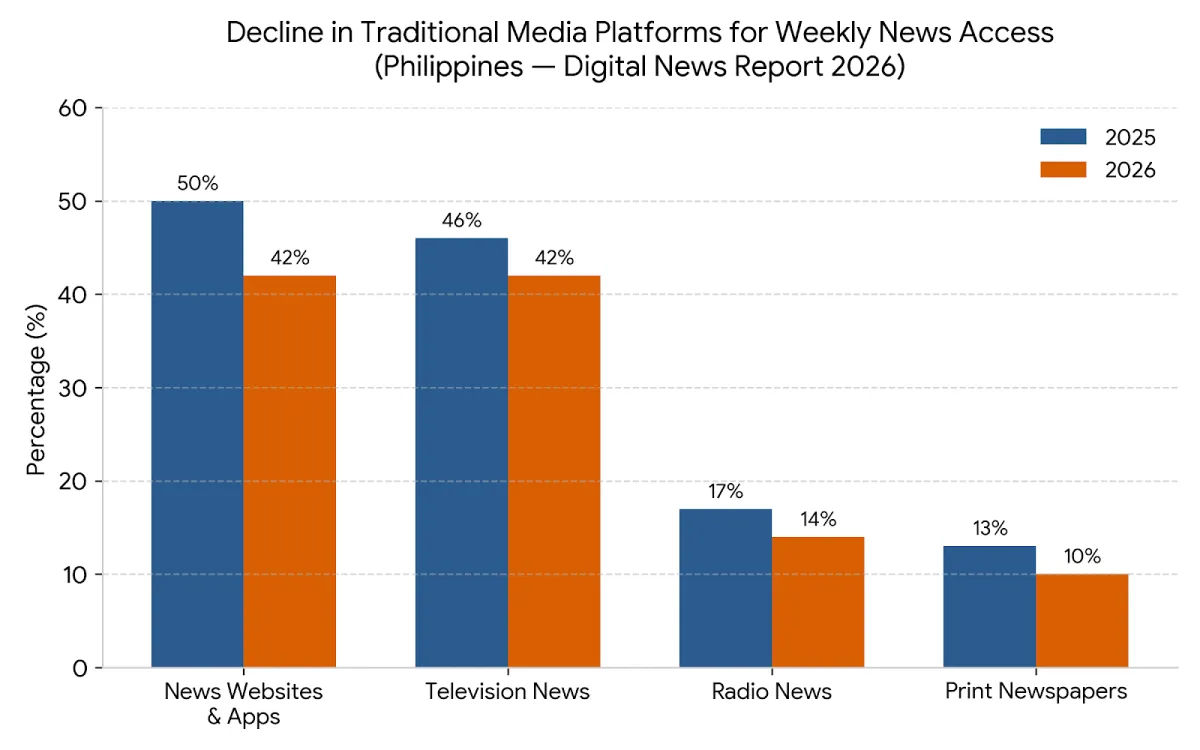
Between 2025 and 2026, reliance on social networks for news rose from 66% to 70%. In stark contrast, traditional mediums experienced a steady decline over the same period:
Television news dropped from 46% to 42%
News websites and applications fell from 50% to 42%
Radio news slid from 17% to 14%
Print newspapers contracted from 13% to 10%
This transition underpins what the report describes as a "second wave" of digital disruption, where online video networks are increasingly undercutting the market share of television broadcasters. Short-form video has become the dominant method for consuming updates online, with a massive majority of Filipinos utilizing platforms such as X, Instagram, TikTok, and Facebook for brief clips.
Concurrently, YouTube has solidified its status as a core alternative for longer journalism, with 52% of local respondents using the platform to watch long-form news coverage.
The migration of audiences to independent content creators and online influencers presents unique challenges for the industry. While 46% of respondents engage with online creators for updates, public opinion remains deeply divided over their reliability. Roughly 22% of users view individual creators as more trustworthy than traditional outlets, while 21% deem them less dependable, with audiences generally valuing influencers for their relatability and entertainment rather than objective impartiality.
The drop in trust also occurs against a backdrop of tightening domestic regulatory pressures. The report highlights that lawmakers in the 20th Congress have proposed packages of bills aimed at establishing strict penalties, including potential prison sentences, for individuals and entities found liable for spreading online disinformation. Press freedom advocates have raised concerns that vague statutory definitions could inadvertently impact standard reporting practices.
Despite the overarching decline in general trust, the report observed that individual news brand trust scores remained relatively stable compared to last year, moving within a narrow three-point margin. However, the multi-year trajectory highlights that most established Philippine news organisations carry lower trust ratings than when the Digital News Report first began tracking them.
The report concluded that while the institutional mandate for reliable journalism remains critical, newsrooms must increasingly navigate a highly fragmented, platform-led environment to retain the public's confidence.
The Reuters Institute Digital News Report 2026 Discussion details these shifting international platform dynamics and the rising challenges of news avoidance and declining public trust.
