



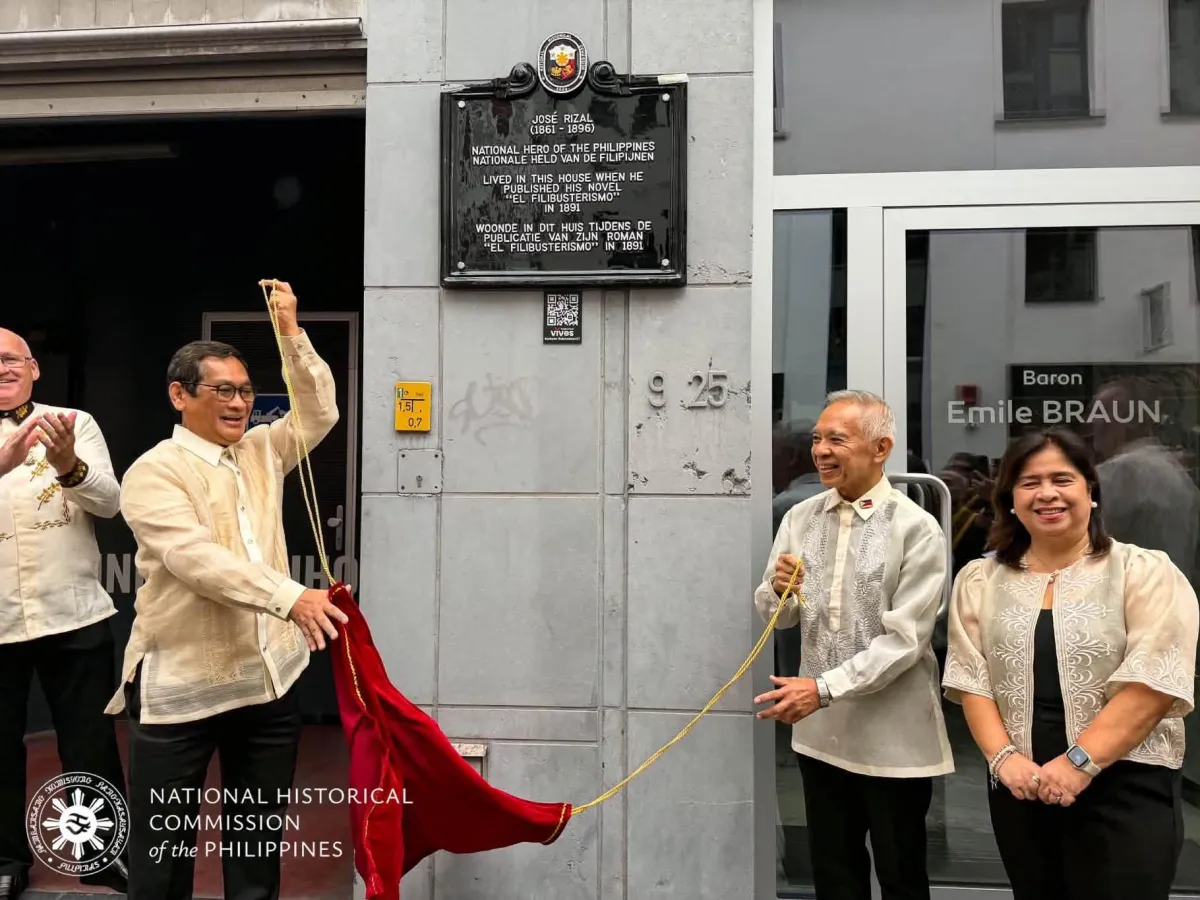
Rizal marker unveiled in Belgium at site where El Filibusterismo was published
Photo caption: The new Rizal marker was unveiled at Lange Kruisstraat 25, 9000 Ghent, Belgium on Saturday, Sept. 19, 2026 by officials of The National Historical Commission of the Philippines (NHCP), the Philippine Embassy in Belgium led and Belgian officials. Photo by: NHCP
GHENT, Belgium — A new historical marker has been unveiled in Ghent, Belgium honouring Philippine national hero Jose Rizal.
The marker installed in Ghent, in northwestern Belgium, is the historic site where Dr. Rizal completed and published his second novel, El Filibusterismo, in 1891.
The National Historical Commission of the Philippines (NHCP) and the Philippine Embassy in Belgium led the unveiling on Saturday, September 19, at Lange Kruisstraat 25, 9000 Ghent, according to reports and NHCP information.
The ceremony was attended by members of the Filipino community in Belgium, the Knights of Rizal and local officials and guests.
The event was followed by a programme at Ghent City Hall, where Philippine Ambassador to Belgium Jaime Victor Ledda, NHCP chairman Regalado Trota Jose Jr. and Ghent officials took part.
The NHCP also turned over replica copies of Noli Me Tangere and El Filibusterismo to the City of Ghent and the Philippine Embassy.
Why Ghent matters to Rizal
Rizal moved from Brussels to Ghent in 1891, where he worked to complete El Filibusterismo, the sequel to his 1887 novel Noli Me Tangere.
He stayed in Ghent with fellow Filipino expatriate students Jose Alejandrino and Edilberto Evangelista, who were studying engineering at the University of Ghent.
Both later became figures in the Philippine Revolution.
El Filibusterismo was published in September 1891.
Rizal dedicated the novel to the memory of Mariano Gomez, Jose Burgos and Jacinto Zamora, the three Filipino priests collectively known as GomBurZa, who were executed by Spanish authorities in 1872.
The novel continued the themes of Noli Me Tangere, portraying abuses and social conditions under Spanish colonial rule. Together, the two novels became important works in the development of Filipino nationalism and the reform movement.
The NHCP said El Filibusterismo was widely praised by Filipino and liberal circles and, together with Noli Me Tangere, contributed to growing opposition to Spanish colonial rule.
A historic site with an older marker
The September 19 ceremony also adds a new layer to a site that has long been associated with Rizal.
The NHCP's historical-sites registry records a Jose Rizal 1861–1896 biographical marker in Ghent, installed in 1959 by the Philippines Historical Committee.
Its inscription states that Rizal lived at the house when he published El Filibusterismo in 1891.
The existing marker is recorded at Henegouwenstraat 9, while the new ceremony was reported at Lange Kruisstraat 25 – so the September 19 installation is not the first Rizal marker in Ghent.
The historical connection itself is well established: the NHCP's Museo ni Rizal notes that Rizal's second novel was published in Ghent in 1891.
Why the marker matters today
The Ghent marker is part of efforts to preserve the places associated with Rizal's life and work outside the Philippines.
Rizal spent much of his productive adult life travelling and studying in Europe. His years abroad exposed him to European intellectual and political currents while he wrote extensively about conditions in the Philippines.
Ghent occupies a particularly important place in that story because it was where he brought El Filibusterismo to publication.
Ghent: 5 years before Rizal’s execution in Manila
The novel was published only months after Rizal's move from Brussels and five years before his execution in Manila in 1896.
The September 19 ceremony therefore connects a physical place in Belgium with one of the most consequential works of Philippine literature and the country's 19th-century nationalist movement.
For the Filipino community in Belgium, the marker also serves as a permanent reminder that a significant part of Philippine history unfolded far beyond the country's shores.
From Ghent, Rizal's words travelled back to the Philippines — and eventually became part of the intellectual foundation of the struggle for reform and national identity.


