



Tensions Rise at Senate Trial: Subpoenas Ordered for VP Finances, NBI Testifies on Security Threats
MANILA — Days seven to nine of Vice President Sara Duterte's impeachment trial saw the Senate court grant a landmark motion for financial subpoenas, setting off heated debates between prosecution and defence panels alongside critical testimony on national security threats.
Day 7 (20 July 2026): Floor Debates, Legal Clashes Over Subpoenas vs Search Warrants, and Financial Records Ruling
The seventh day of the Senate impeachment trial commenced with heated manifestations from senator-judges addressing personal controversies and floor procedures.
Senator-judge Robinhood "Robin" Padilla took the floor to clarify media reports regarding an Office of the Ombudsman investigation involving Senator Ronald "Bato" dela Rosa, asserting his compliance with legal processes and calling for fairness.
Senator-judge Erwin Tulfo immediately called out the use of trial time for personal statements:
Senator-judge Erwin Tulfo: "Because the time we waste here to defend ourselves... is an injustice to the Vice President. 'Yung oras po na ito dapat ilaan natin sa pakikinig sa depensa ng Vice President sa mga akusasyon laban sa Vice President, hindi po pagdedepensa sa mga sarili natin. Kung tayo ay inaakusahan ng kung anong mga ahensya... this is not the right forum. This is not the right place. Dapat sa session natin."
Senator-judge Alan Peter Cayetano defended Padilla's right to speak, citing the court's institutional integrity and invoking a famous line attributed to former Senator Joker Arroyo:
Senator-judge Alan Peter Cayetano: "Regarding the waste of time here, sabi ni Senator Joker Arroyo, 'it is useless to argue a legal point with a non-lawyer'... The integrity of the court and the justices or judges is always relevant."
Senator-judge Vicente "Tito" Sotto III intervened to resolve the impasse—noting, "I do not have four years of law, but I have 29 years of lawmaking"—before formally moving to refer all manifestations non-essential to the trial to regular legislative sessions. Presiding Officer Francis Escudero approved the motion.
Clashes on Pre-Trial House Procedures and Impeachment Court Scope
During interpellations regarding Article II, Senator-judge Alan Peter Cayetano questioned prosecution counsel Rep. Chel Diokno on how the House Justice Committee conducted its preliminary proceedings prior to transmitting the Articles of Impeachment, questioning the factual basis used by the House.
Rep. Chel Diokno pushed back against the line of inquiry, questioning whether the Senate impeachment tribunal was being asked to act as a review body over a co-equal branch:
Rep. Chel Diokno (House Prosecution Panel): "Are we now turning this Honorable Impeachment Court into an appellate court or a review court over the internal proceedings of the House of Representatives? The Constitution gives the House the exclusive power to initiate all cases of impeachment. Once transmitted, the issue before this court is whether the evidence supports the charges, not how the House Committee on Justice conducted its preliminary hearings."
Pia Cayetano vs Chel Diokno: Search Warrants vs Subpoenas
Senator-judge Pia Cayetano interrogated the prosecution panel on constitutional protections and due process regarding bank secrecy and personal privacy. Cayetano cited the landmark 1967 Supreme Court jurisprudence Stonehill v. Diokno—a case famously involving prosecutor Chel Diokno's father, former Justice Secretary Jose W. "Ka Pepe" Diokno—which established the prohibition against general search warrants and the "fruit of the poisonous tree" doctrine. Cayetano questioned whether subpoenaing almost 20 years of private financial records acted as an invasive search.
Rep. Chel Diokno distinguished the fundamental legal difference between a search warrant and a court-issued subpoena:
Senator-judge Pia Cayetano: "In the absence of an authentic supporting record, what factual basis did the prosecution rely on to say that the allegations were sufficient in form and substance... and does compelling every single bank document not run afoul of constitutional protections against unreasonable searches?"
Rep. Chel Diokno: "May malaking-malaki pong pagkakaiba ang search warrant sa subpoena. A search warrant is governed by the Bill of Rights because of its invasiveness—it allows authorities to enter a home or office and immediately seize property. A subpoena, on the other hand, is governed by Rule 21 of the Rules of Civil Procedure. It merely directs an institution or person to produce specific documents before the court. 'Pag naglabas ang isang hukuman ng subpoena, itong mga records ay hindi po sya considered yet as evidence. They are simply produced, and the admissibility will only be determined after they are formally offered by the parties. Confidentiality cannot trump constitutional accountability."
The Subpoena Decision & Defence Reaction
Following arguments, Presiding Officer Francis Escudero announced the majority ruling granting subpoenas for bank, BIR tax, and Anti-Money Laundering Council (AMLC) records of the Vice President and her husband, Atty. Manases "Mans" Carpio, covering 2007 to 2021. Foreign-currency deposits were excluded pursuant to Republic Act No. 6426, and two corporate entities (JTC Group of Companies and Pikimong Pikimong Philippines Corp.) were exempted due to lack of direct links.
In post-trial statements, lead prosecutor Chel Diokno called the order a "victory for the Filipino people".
Defence spokesperson Atty. Michael Poa stated that while the defence team respects the decision, they were "shocked" upon discovering that significant portions of the written ruling had already been drafted prior to the formal opening of trial proceedings on 6 July 2026:
Atty. Michael Poa (Defence Counsel): "While we respect the decision of the Impeachment Court, we were quite shocked to learn that substantial portions of this written order were apparently already prepared even before the formal start of the trial on July 6. Nevertheless, we anticipated this possibility, and it is not a major setback for our overall defence."
Day 8 (21 July 2026): NBI Leadership Testifies on Threats and Alleged Assassination Plot
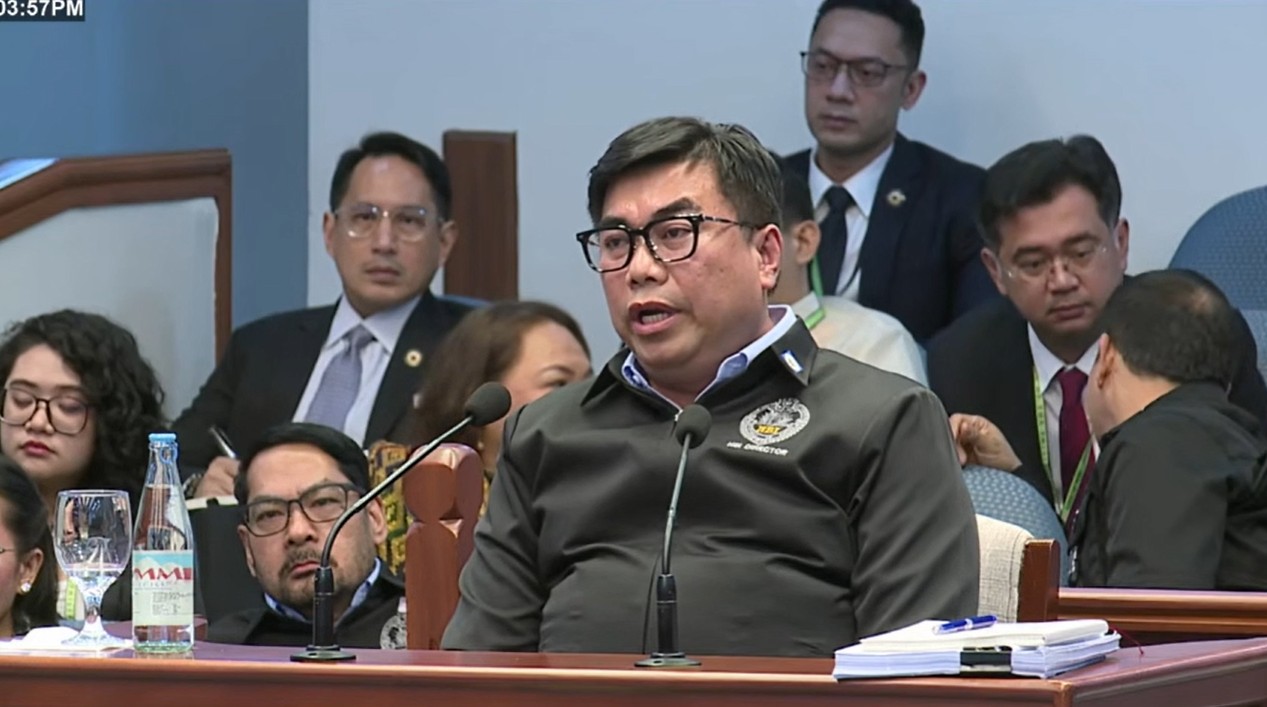
Day 8 commenced with Presiding Officer Escudero issuing an official admonition to National Bureau of Investigation (NBI) Director Melvin Matibag regarding public media comments he had made concerning individual senator-judges.
Presiding Officer Francis Escudero instructed the witness at the outset:
"Kindly avoid statements pertaining to individual members of this court."
Director Matibag appeared as the final witness presented by the House prosecution panel under Article IV, which charges the respondent with grave threats, betrayal of public trust, and inciting to sedition. House impeachment trial spokesperson Zia Alonto Adiong explained at a pre-session briefing that Matibag was called to resolve unanswered questions left by previous NBI witnesses—including Senior Agent John Mark Calilung and BARMM Regional Director Jeremy Lotoc—and provide institutional context regarding the overall investigation.
During direct examination conducted by prosecutor Rep. Gerville Luistro, Matibag testified that the NBI had elevated its probe beyond standard administrative complaints, forming a special task force combining Cybercrime and Transnational Crimes divisions to evaluate an active security concern.
Matibag testified on the nature of the investigation:
"Our observation is that this is no longer merely a threat but a plan. We believe the vice president announced her plan to kill the president of the Philippines, as well as the other individuals she said she wanted killed during her press conference."
To establish what prosecutors described as a "pattern of violence," video footage from 2011 was played inside the chamber showing the Vice President punching court sheriff Diego Fernando during a demolition operation in Davao City. Matibag noted that NBI Cybercrime Agent Edgar Apolonio had been directed to preserve and authenticate digital recordings from the 12 April 2026 RAGE rally.
Prosecutors also introduced excerpts from an unnotarised affidavit authored by former police officer Arturo Lascañas regarding Davao Death Squad operations. Defence attorney Mark Vinluan objected, arguing that reading unverified statements from a witness not present in court created a misleading impression. Presiding Officer Escudero sustained the objection in part, cutting short the reading and clarifying that the document was admitted solely to demonstrate the material reviewed by the NBI during its preliminary investigation, rather than to establish the truth of its contents.
During questioning by senator-judges, Senator-judge Bam Aquino asked about the operational assessment of the threats:
Senator-judge Bam Aquino: "In your assessment as NBI Director, what is the probability that the respondent would carry out or hire someone to carry out such threats?"
NBI Director Melvin Matibag: "100 percent [certain] because she said so."
At the close of the session, Presiding Officer Escudero announced an adjustment to the trial calendar to accommodate President Ferdinand R. Marcos Jr.'s State of the Nation Address (SONA) and regular legislative duties. The court ordered that no trial sessions would be held on 27 July (SONA) or 28 July (minority Kontra-SONA), with proceedings resuming on 29 July 2026. Additionally, the tribunal recalled, without prejudice to reissuance, subpoenas previously served to former Land Bank branch managers Violeta Constantino and Nenita Camposano after both legal teams indicated their testimony was not yet required.
Day 9 (22 July 2026): Cross-Examination Scrutinises Investigative Methodology
The ninth day of proceedings focused on the cross-examination of NBI Director Melvin Matibag by defence counsel Mark Vinluan.
Defence attorneys subjected the NBI's investigative methodology to detailed scrutiny, questioning whether the bureau's findings were premature given that investigators were still following operational leads. Vinluan challenged the witness on the evidentiary weight of public speeches, political rallies, and unnotarised affidavits, arguing that public commentary does not satisfy the legal standards required to establish actionable criminal intent or impeachable offences.
During questioning regarding threat levels, Matibag confirmed under oath that while the NBI possessed actionable intelligence indicating a continuing threat to the life of the President, the agency held no actionable intelligence indicating a threat to the life of the Vice President. Matibag also maintained under cross-examination that public opinion surveys held no bearing on the NBI's factual findings.
A minor procedural exchange occurred when Director Matibag attempted to disallow a line of questioning from defence counsel:
Presiding Officer Francis Escudero: "The Presiding Officer would like to remind the witness to kindly avoid making a ruling for and on behalf of the Presiding Officer."
NBI Director Melvin Matibag: "I'm sorry, your Honour."
Presiding Officer Francis Escudero: "But the gentleman would have been correct."
Following the conclusion of testimony, both legal panels issued formal post-trial summary statements:
House Prosecution Panel Spokesperson Zia Alonto Adiong stated:
"The testimony of Director Matibag successfully completed the presentation of evidence under Article IV. The facts presented demonstrate that the public statements were not hypothetical, establishing the necessary evidentiary foundation for betrayal of public trust."
Defence Legal Team Statement:
"The cross-examination demonstrated that the prosecution's allegations rely on speculative interpretations and media clips. Without direct witnesses or physical corroboration, unverified rhetoric fails to meet the high constitutional threshold required for an impeachable offence."
