



The Philippines wants to be an AI hub. But it doesn't have enough power
Photo by: PNA
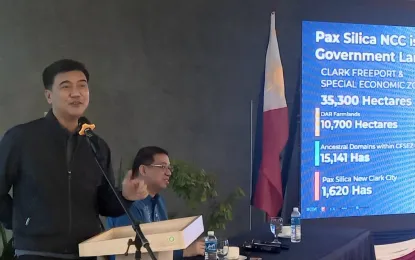
No power, no AI data centers: BCDA President and CEO Joshua Bingcang (left) and BOI Managing Head Ceferino Rodolfo brief the media on the Pax Silica initiative at New Clark City, Tarlac, on Aug. 7, 2026. The initiative aims to build an AI manufacturing hub targeting $200 billion in exports over 30 years.
MANILA — The Philippines wants to position itself at the heart of the global artificial intelligence boom. But one of the country's top investment officials has delivered an unusually blunt assessment of what may be the biggest obstacle to that ambition: there is not enough electricity to attract the world's largest AI data centers.
Bases Conversion and Development Authority (BCDA) President and Chief Operating Officer Joshua Bingcang said Tuesday that a major AI company—one he described as a “trillion-dollar” company—had spent about two months studying New Clark City (NCC) in Tarlac as a potential site for a hyperscale data center.
The investor eventually chose Malaysia.
The reason, Bingcang said, was simple.
“Wala tayong kuryente,” he said.
The Philippines does not have the power supply the company requires.
“Even if we provided them incentives, they wouldn’t move here unless the ecosystem will support their business,” Bingcang said at a media briefing attended by business-group representatives.
The company was not identified.
The episode is significant: It exposes a contradiction at the center of the Philippines' AI strategy: the country is aggressively marketing itself as an emerging AI and advanced-manufacturing hub while its power infrastructure remains a constraint on the very companies driving the AI boom.
And nowhere is that contradiction more visible than in New Clark City.
Malaysia got the investment: The Philippines got the lesson
Bingcang said he personally tried to persuade the unnamed investor to choose New Clark City, even offering to have its building constructed.
He told the company that the area's power situation would improve by 2028.
It left anyway.
“Kahit yayain ko sila ayaw nila,” Bingcang said. “Sabi ko nga may niligawan ako, gagawin ko ang building nila, pero umalis siya, walang kuryente.”
In other words, the Philippines could offer land and incentives, but the investor could not afford to wait for the country's infrastructure to catch up with its business requirements.
That is increasingly how the global data-center race works.
For ordinary manufacturing investments, governments can compete through tax incentives, cheap land, labor costs and market access.
For hyperscale AI infrastructure, those advantages matter — but only after a much more fundamental question has been answered: Can you deliver hundreds of megawatts of reliable power when the facility needs it?
AI computing is exceptionally electricity-intensive.
Training and running large AI models requires enormous clusters of high-performance processors, while the facilities that house them must operate continuously and maintain extremely high reliability.
That makes electricity not merely an operating expense but a prerequisite for investment.
For the Philippines, the problem is particularly acute.
New generation capacity alone is not enough. Investors also need transmission infrastructure, grid connections, water, cooling systems and a predictable timetable for bringing all of those systems online.
The unnamed investor apparently decided Malaysia offered a more credible answer.
The Malaysia advantage
Malaysia has become one of Southeast Asia's biggest beneficiaries of the data-center boom, particularly in Johor, just across the border from Singapore.
Its advantage is not simply cheap land or proximity to Singapore. The country has been building an ecosystem around large-scale data centers, including power infrastructure, industrial estates, fiber connectivity and access to renewable-energy sources.
That gives Malaysia an important advantage over countries that are still trying to assemble the infrastructure after investors arrive.
The Philippines is now trying to close that gap.
But the timeline matters.
For a tech company racing to expand AI capacity, an assurance that sufficient electricity will be available two years down the road, in 2028, may be less valuable than electricity that can be contracted and delivered today.
That is the lesson from the investment that got away.
So what exactly is Pax Silica?
The electricity issue has become intertwined with another controversy in New Clark City: the planned Pax Silica AI-native industrial hub.
When the Philippines joined the US-led Pax Silica initiative in April, the government announced plans for a roughly 4,000-acre, or 1,618-hectare, industrial zone in New Clark City focused on AI, semiconductors, critical minerals and advanced manufacturing.
The announcement generated an understandable assumption that the Philippines was preparing to host giant AI data centers.
Officials now insist that is not the plan.
Bingcang said the government never announced that a hyperscale data center would be built at the Pax Silica site.
Trade Undersecretary and Board of Investments Managing Head Ceferino Rodolfo was even more explicit.
“Not a single AI company will build and operate a data processing center here,” he said.
Instead, Pax Silica is being designed around the industrial infrastructure behind AI: components, semiconductors, advanced manufacturing and other technologies that feed the global AI supply chain.
That distinction is important.
The Philippines is not necessarily trying to become the next giant server farm of Southeast Asia.
It is trying to become the factory floor behind the server farms.
That may actually be the more realistic strategy
There is a strategic logic to this. A hyperscale data center can represent an enormous capital investment, but its permanent employment footprint can be relatively modest compared with a large manufacturing operation.
An advanced-manufacturing ecosystem, by contrast, can involve semiconductor facilities, electronics plants, equipment makers, component suppliers, logistics companies, engineering firms and research institutions.
That creates a wider network of economic activity.
The government says the Pax Silica hub could generate as much as $200 billion in exports over 30 years, reflecting its ambition to move the Philippines higher up the global technology supply chain.
That is a different proposition from simply hosting power-hog server farms.
The goal is to make things that go into the servers.
And the Philippines has some advantages in that space: an established electronics and semiconductor sector, an English-speaking technical workforce, proximity to major Asian markets and a strategic position within the US-Japan-Philippines Luzon Economic Corridor (LEC).
Critical minerals
The United States has also framed Pax Silica as a way of securing technology supply chains ranging from critical minerals and semiconductors to advanced manufacturing and AI infrastructure.
So the Philippines does not necessarily have to beat Malaysia at the data-center game to benefit from the AI boom.
It could make money selling Malaysia—and the rest of the world—the hardware that AI needs.
But the power problem doesn't disappear
There is an uncomfortable catch.
Even a manufacturing-centered AI hub needs substantial electricity.
And if the Philippines wants to attract semiconductor fabrication, advanced electronics and other high-value industries, it will eventually face the same infrastructure question confronting data-center developers:
Where will the power come from?
Bingcang said BCDA is considering dedicated power-generation facilities within the Pax Silica site.
The government is also proposing its own approach to water management, including rainwater capture, impounding facilities and underground storage. BCDA says groundwater will not be tapped for the hub.
Those plans are intended to address one of the biggest concerns surrounding large AI and semiconductor projects: whether they will place additional pressure on already constrained water and electricity resources.
The government's response is essentially to build the infrastructure around the industrial zone rather than expect existing systems to absorb the additional demand.
That could work.
But it will require money, engineering and—most importantly—execution.
The real competition isn't incentives
For years, Philippine investment promotion has leaned heavily on incentives.
But Bingcang's story suggests the competitive equation is changing.
A tax break cannot compensate for an unreliable grid.
Cheap industrial land cannot compensate for the absence of transmission capacity.
A promise of future power cannot necessarily compete with a neighboring country that can offer a signed electricity contract today.
That is why the loss of one unnamed investor matters beyond the identity of the company.
It provides a real-world test of the Philippines' pitch to global AI companies.
And, for now, the answer was no.
The Philippines still has a window
The situation is not hopeless.
The Philippines is already developing its data-center industry, while the government is trying to accelerate investment in generation and transmission. The country also has an opportunity to position itself differently from Singapore and Malaysia by concentrating on advanced manufacturing and other parts of the AI supply chain.
The Pax Silica project could therefore become an important experiment.
If the Philippines can provide reliable power, water and logistics while attracting semiconductor, electronics and AI-component manufacturers, it could capture a much broader economic benefit than a single hyperscale data center would provide.
But if infrastructure projects continue to arrive after the investors they are supposed to attract, the country risks remaining a promising market rather than becoming a serious regional technology hub.
Key challlenge
That is the central challenge facing New Clark City.
The Philippines has the land, it has the workers, it has the geopolitical partnerships. It has the ambition.
What it does not yet have — at least not at the scale demanded by the world's biggest AI companies — is enough ready, reliable power.
In the AI economy, electricity is the one incentive that cannot be replaced by another.


