



US and Iran sign preliminary agreement to end Middle East war and reopen Strait of Hormuz
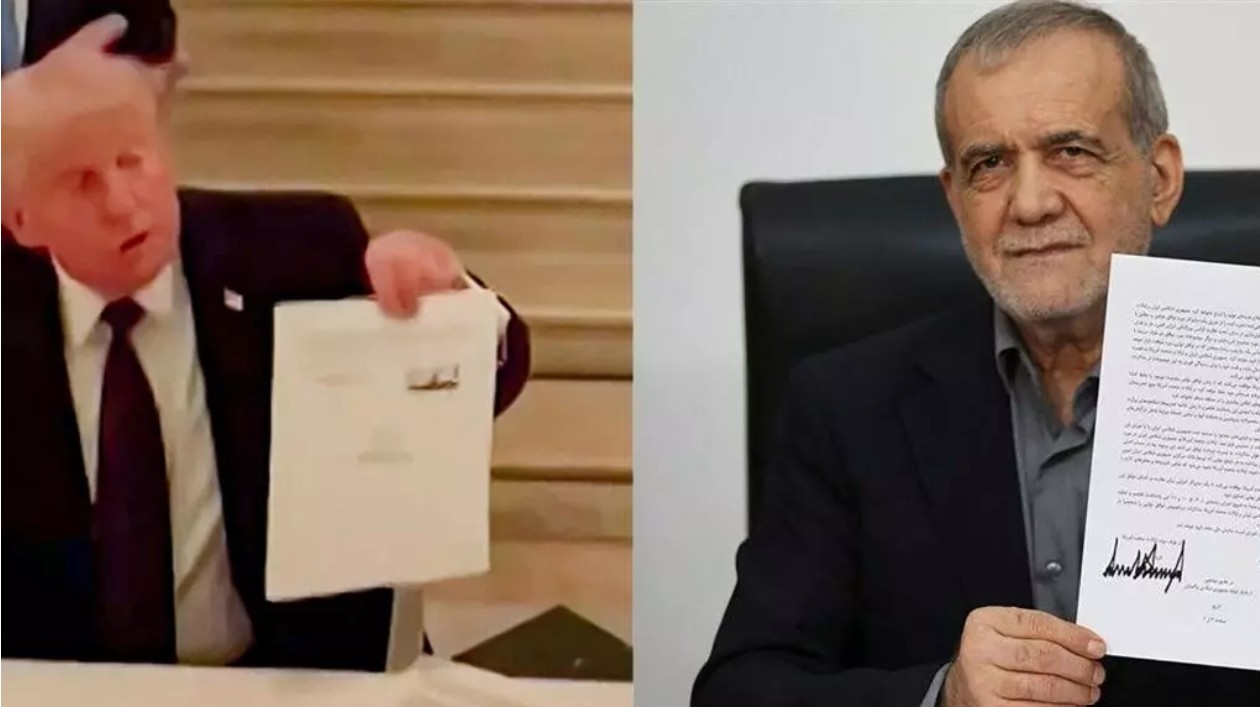
A composite image of US President Donald Trump and Iranian President Masoud Pezeshkian brandishing the signed MOU between Tehran and Washington. © Handout via AFP
VERSAILLES, France — United States President Donald Trump and Iranian President Masoud Pezeshkian have signed a historic 14-point preliminary peace agreement, effectively bringing an immediate end to the 110-day war in the Middle East and initiating the reopening of the crucial Strait of Hormuz.
President Trump signed the document, known as the Islamabad Memorandum of Understanding (MOU), on the evening of 17 June 2026 during a G7 summit dinner at the Palace of Versailles in France. President Pezeshkian signed the text remotely from Tehran, concluding weeks of tense mediation spearheaded by Pakistan and Qatar.
The agreement marks a dramatic breakthrough in a conflict that began on 28 February 2026, when strikes launched by the US and Israel prompted extensive retaliatory drone and missile salvos from Iran. The ensuing regional warfare severely depleted military stockpiles, sent global energy prices soaring, and caused severe disruption to international shipping.
Under the terms of the newly signed memorandum, both nations have committed to an immediate and permanent termination of military operations on all fronts, explicitly including the conflict in Lebanon.
The deal outlines several major immediate actions and a 60-day framework to negotiate a comprehensive final treaty:
Waterway Reopening: Iran will immediately begin clearing mines to facilitate the toll-free passage of commercial vessels through the Strait of Hormuz. The gradual reopening will take place over the next 30 days, with free transit guaranteed for the duration of the 60-day negotiating window.
Sanctions and Blockade Relief: The US will immediately dismantle its naval blockade of Iranian ports. Concurrently, the US Department of the Treasury will issue immediate waivers allowing Iran to export crude oil and petroleum derivatives to international markets, providing instant economic relief to Tehran.
Nuclear Commitments: Iran has reaffirmed its commitment not to procure or develop nuclear weapons. As a baseline for upcoming technical talks, Tehran has agreed to a mechanism to dilute its highly enriched uranium stockpile through on-site down-blending supervised by the International Atomic Energy Agency (IAEA).
Reconstruction Fund: If a final treaty is successfully concluded within the 60-day period, the US, alongside regional partners, will establish a USD 300 billion reconstruction and economic development fund for Iran.
Whilst global stock markets reacted with record gains following the announcement, the agreement has faced mixed political reactions. French President Emmanuel Macron welcomed the deal for halting severe economic instability, and the G7 leaders issued a joint statement offering implementation support. However, critics within the US Congress have expressed concern that the front-loaded sanctions relief and lack of immediate ballistic missile curbs represent significant concessions to Tehran.
President Trump defended the agreement, stating it averted a "worldwide depression", though he later warned reporters that the US remains prepared to resume military action if Iran fails to adhere to the framework. Formal technical discussions to iron out the final treaty are scheduled to begin in Doha.


