



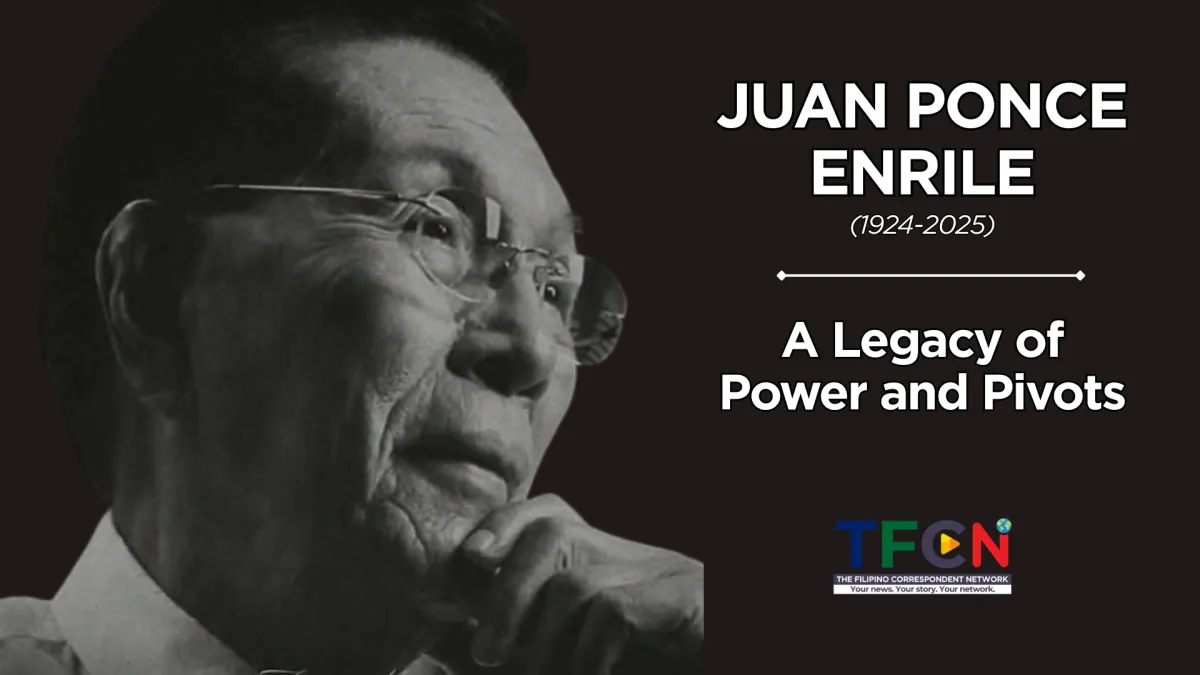
Veteran Statesman Juan Ponce Enrile, Former Senate President And Chief Legal Counsel, Passes Away
MANILA, Philippines – Juan Ponce Enrile, one of the Philippines’ most enduring and storied political figures, passed away on Thursday, November 13, at 4:21 p.m. at the age of 101, according to official records. He was serving as the Chief Presidential Legal Counsel at the time of his death.
His daughter, Katrina Ponce Enrile, shared the news in a family statement confirming that the veteran statesman passed away peacefully at home, surrounded by his loved ones.
"Chief Presidential Legal Counsel Juan Ponce Enrile peacefully returned to his Creator Thursday, November 13, at 4:21 p.m., surrounded by family in the comfort of their home," the announcement read.
Katrina also shared his final moments and a request for privacy for the grieving family. "It was his heartfelt wish to take his final rest at home, with his family by his side. We were blessed to honor that wish and to be with him in those sacred final moments," she said.
She reflected on his dedication to public service, stating that her father "dedicated much of his life to the service of the Filipino people."
"At this time, we humbly ask for the public’s understanding as our family takes a brief moment to grieve privately and honor his memory together in quiet and in peace," Katrina requested. She extended the family’s deep gratitude for the support they have received: "Your kindness means more than words can express."
While official records state Enrile passed on at age 101, his son, Jack Enrile, previously indicated that records retrieved from the Aglipayan Church in Cagayan show a birthdate of June 22, 1922, which would place his age at 103. Details regarding public viewing and funeral arrangements are forthcoming.
A Career Defined by Power and Pivots
Juan Ponce Enrile’s political career spanned over five decades, placing him at the center of the country’s most transformative historical events. A highly accomplished Harvard-trained lawyer, Enrile first joined government service in 1966 as the Undersecretary of Finance.
His rise to prominence came under the administration of President Ferdinand Marcos Sr., where he held several significant roles, including Secretary of Justice (1968–1970) and, critically, Minister of National Defense (starting in 1970). As Defense Minister, he played a central role in the declaration and implementation of Martial Law in 1972, serving as the official martial law administrator for nearly the entire period.
The defining moment of his career came in February 1986 when Enrile, alongside former Armed Forces Vice Chief of Staff Fidel V. Ramos, announced their withdrawal of support from the Marcos regime. This split ignited the non-violent People Power Revolution, which ultimately led to the ouster of Marcos. Enrile served briefly as Defense Secretary under the ensuing Corazon Aquino administration before returning to the legislative branch.
Enrile went on to serve multiple terms in the Senate (1987–1992, 1995–2001, 2004–2016), and also served in the House of Representatives (1992–1995). During his time in the Senate, he was designated Chairman of several key committees, including Ways and Means, and Justice and Human Rights, and was recognized for his active participation in plenary debates on legislation like the Expanded Value Added Tax (EVAT) and the Human Security Act.
He reached the pinnacle of his legislative career when he served as the 21st President of the Senate of the Philippines from 2008 to 2013, overseeing the passage of important measures such as the Expanded Senior Citizens Act and the Anti-Torture Act.
Enduring Controversies and Legal Battles
Enrile’s long political life was continually intertwined with major legal and political controversies, including allegations of corruption and his central role during the Martial Law era.
The most prominent legal challenge of his later career was his alleged involvement in the multibillion-peso Priority Development Assistance Fund (PDAF) scam. In 2014, while serving as a senator, he was indicted on charges of plunder and 15 counts of graft. Prosecutors alleged that he misused ₱172.8 million of his PDAF allocation between 2004 and 2010 by channeling it to "ghost" non-government organizations linked to alleged scam mastermind Janet Lim Napoles in exchange for kickbacks. Enrile was arrested in July 2014, but the Supreme Court granted him bail in 2015 on humanitarian grounds, citing his advanced age and frail health.
In a highly significant development that occurred just weeks before his death, the Sandiganbayan Special Third Division acquitted Enrile, along with his former chief of staff, Jessica Lucila "Gigi" Reyes, of all 15 graft charges on October 24, 2025. The anti-graft court ruled that the prosecution failed to prove guilt beyond a reasonable doubt.
Beyond the PDAF case, Enrile was also consistently associated with the declaration of Martial Law in 1972, serving as the official administrator. A key controversy surrounding this period was the alleged "fake ambush" on his convoy, which Marcos Sr. cited as a pretext for the martial rule. Enrile and then-Armed Forces Vice Chief of Staff Fidel V. Ramos later admitted during the 1986 People Power Revolution that the ambush was staged. His time in the Executive Branch also saw him preside over the controversial Philippine Coconut Authority, which was linked to the Coco Levy Fund anomaly.
Following a brief hiatus from public office, Enrile returned in 2022 to serve in the Executive Branch one final time, accepting the role of Chief Presidential Legal Counsel under President Ferdinand “Bongbong” Marcos Jr. His life in government, marked by periods of immense power and historic changes, leaves an indelible record in the Philippines’ political history.
