



Joint Verification System: How forged OEC is detected
By TFCN Correspondent
Photo by DICT/DMW: For the Filipina stopped at Clark, the digital check may have prevented her from boarding a flight into an overseas employment arrangement that Philippine authorities had not verified.
CLARK, Philippines: The Manila government's drive to digitize verification of deployment documents for overseas Filipino workers (OFWs) is starting to bear fruit.
Recently, a forged Overseas Employment Certificate (OEC) nearly sent a Filipina to Dubai — until airport authorities caught it with a simple database query.
On July 24, a 45-year-old Filipina bound for Dubai was stopped at Clark International Airport after immigration officers detected that her Overseas Employment Certificate, or OEC, had been falsified.
BI-DMW: Joint Verification System
The incident highlights how a new digital link between the Bureau of Immigration (BI) and the Department of Migrant Workers (DMW) is making it harder for forged documents to pass airport checks.
The woman, not named in the report, was scheduled to travel to Dubai on a connecting flight when immigration officers flagged her OEC during a routine departure inspection.
A real-time cross-check with the DMW database showed that the document had been altered.
The case was referred to the Inter-Agency Council Against Trafficking (IACAT) for assistance and possible action against people who may have attempted to facilitate her deployment using a counterfeit document.
According to the BI, the woman said she had been recruited as a nanny for an Egyptian employer and claimed she did not know the OEC was fake.
The 45-year-old Filipino told authorities that her recruiter had handed her the document.
BI Commissioner Joel Anthony Viado has highlighted the role of the joint verification system in detecting fraudulent OECs and urged aspiring OFWs to use official processing channels.
In a previous fake-OEC interception, the BI said its system detected that an OEC submitted by a passenger was not registered in the database;
DMW personnel subsequently confirmed it was counterfeit.
“The use of our joint verification system with the DMW has proven crucial in detecting fraudulent documents,” Viado told local media.
OFW Pass/Travel Pass
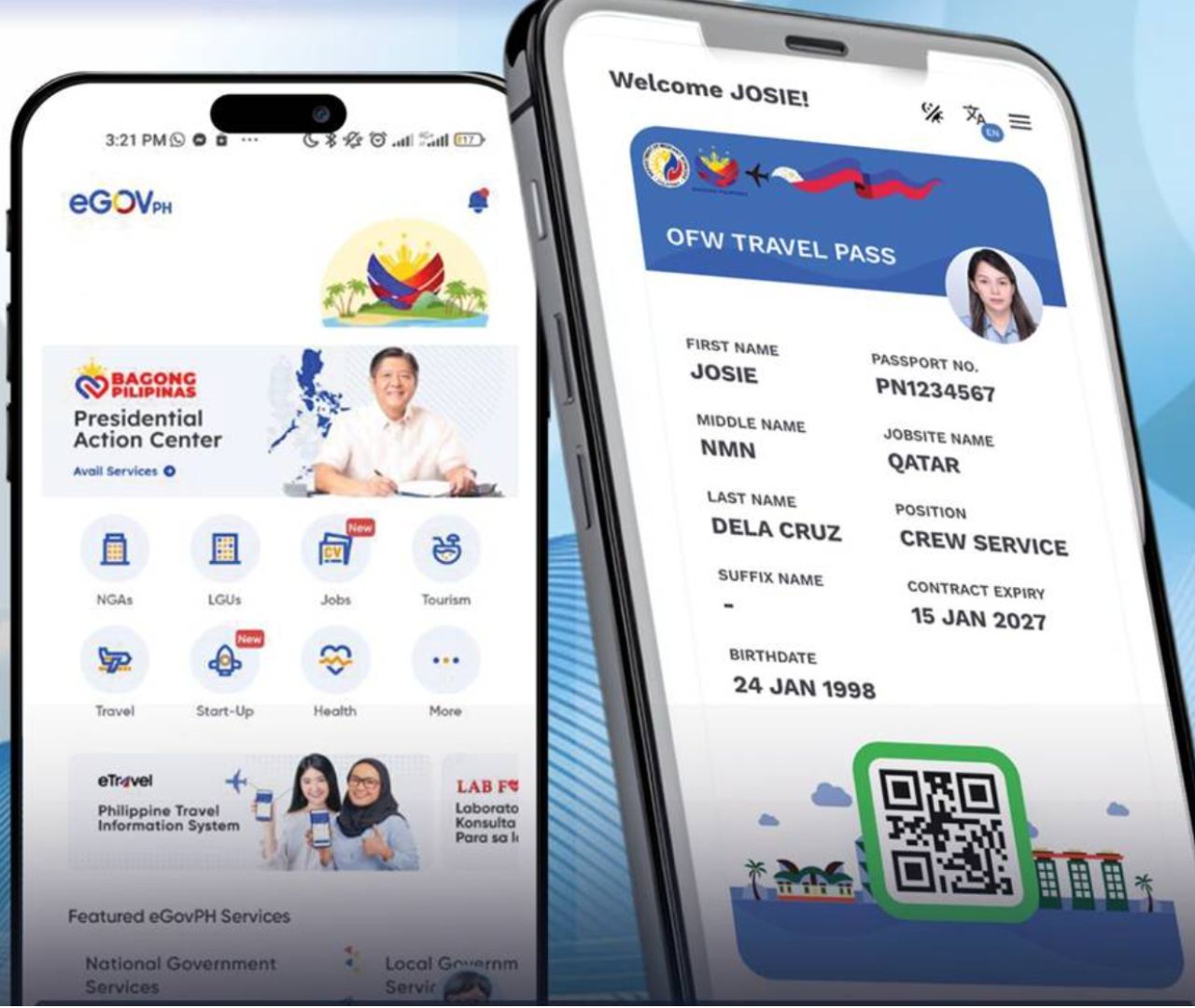
The DMW has rolled out the OFW Pass/Travel Pass, which can serve as a digital exit clearance for qualified returning OFWs.
There's an important distinction: DMW guidance says returning workers with the same employer, job and country can use the digital Travel Pass rather than the traditional printed OEC.
DMW describes the digital system as a way to make documentation more accessible while improving verification.
Its FAQ contrasts the OFW Pass with the paper OEC, noting that the digital pass can be accessed through the app and carries a QR code.
What is an OEC — and why is it important?
The Overseas Employment Certificate (OEC) is a government-issued document used to establish that a Filipino worker leaving the Philippines for employment abroad has been properly documented.
The BI describes it as an important “exit clearance” for OFWs, who are exempted from paying travel tax.
It serves as proof that the worker has been properly documented and is departing through legal and secure employment channels.
Worker protection
The OEC system is designed not merely as an immigration requirement but also as a worker-protection mechanism.
The documentation process allows authorities to verify an overseas job, employer and employment arrangements and helps identify potentially illegal recruitment or trafficking situations before a worker leaves the country.
The DMW's own pre-employment orientation program specifically highlights the OEC as an important requirement and provides information on avoiding illegal recruitment.
How the fake OEC was caught
The latest development in the Clark case is the digital connection between the BI and DMW databases.
Instead of relying solely on the appearance of a printed certificate, immigration officers can cross-check the document against government records instantly.
That creates a crucial difference: A convincing-looking fake document can still fail if there is no matching government record.
'Fake OEC sold on social media'
The BI has also warned that counterfeit OECs are increasingly being sold through unauthorised intermediaries and social-media channels.
In a previous Clark case, a Filipina said she bought a fake OEC through WhatsApp for ₱7,200 before attempting to fly to another country.
For authorities, the concern goes beyond document fraud.
A Filipino worker who leaves the country using falsified employment documents may be entering an overseas job that has not been properly verified by Philippine authorities.
That can expose the worker to:
illegal recruitment;
contract substitution;
exploitation or forced labor;
trafficking;
an unverified employer or job;
lack of proper insurance and welfare protections; and
difficulties obtaining government assistance overseas.
That is why the Clark passenger was referred to IACAT, rather than the incident being treated simply as an immigration-document violation.
The objective is also to determine whether the woman was a victim of recruitment fraud and to identify the recruiter or other people involved.
Warning for Filipinos heading overseas
The BI has repeatedly urged aspiring OFWs not to rely on recruiters, fixers, friends or social-media contacts who promise to arrange employment documents outside official channels.
The bureau previously warned Filipinos against buying supposedly legitimate employment documents from Facebook, WhatsApp and other messaging platforms, after intercepting passengers carrying counterfeit OECs.
The DMW also maintains official online services for overseas employment registration, OEC processing and transaction verification.
For workers, the safest rule is simple:
If someone offers to “fix” an OEC for you, verify it directly with the DMW before going to the airport.
OEC is also changing digitally
There is another important development: the Philippine government has been moving OFW documentation toward digital systems.
The DMW has rolled out the OFW Pass/Travel Pass, which can serve as a digital exit clearance for qualified returning OFWs. DMW guidance says returning workers with the same employer, job and country can use the digital Travel Pass rather than the traditional printed OEC.
DMW explains that the digital system makes documentation more accessible, and boosts verification. The digital pass can be accessed through the app and carries a QR code.
This is in contrast to the OFW Pass, with the paper OEC.
This means the broader direction is clear: Less reliance on paper. More reliance on government databases and digital verification.
What is an OEC?
Overseas Employment Certificate, an official document used to verify and clear properly documented Filipino workers departing for overseas employment.
It is part of the government's broader system for protecting OFWs from illegal recruitment and trafficking.
The Clark case shows why workers should never buy an OEC from a recruiter, fixer or social-media contact without independently verifying the transaction with the DMW.
One forged certificate can cost more than a missed flight — it can put a worker's safety and legal status at risk.
READ MORE:
Filipino In Dubai Hits ₱333 Million (Dh20 Million) Jackpot In Big Ticket Draw
22 Filipinos in the UAE graduate from Ateneo Leadership and Social Entrepreneurship program
Two Filipino seafarers killed, one missing in Black Sea drone attacks


