



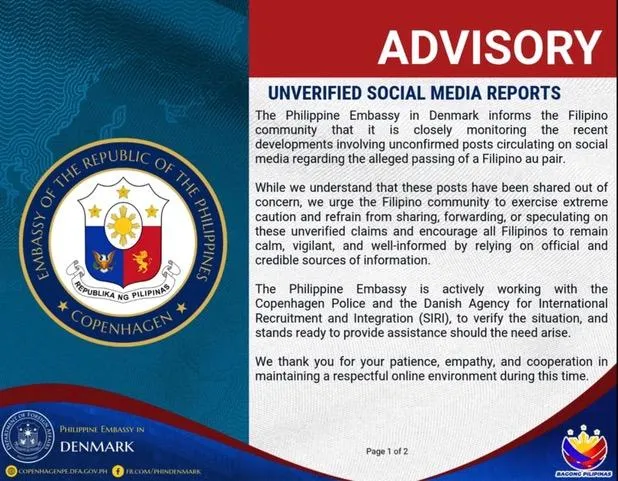
Unverified Social Media Reports of Filipina Au Pair’s Passing Stir Alarm and Fraud Controversy in Denmark
COPENHAGEN, Denmark — The Filipino community in Denmark is reeling from unverified, anonymous reports circulating on social media regarding the alleged passing of an unnamed Filipina au pair. The posts, shared across various closed Filipino community groups on Facebook, have ignited immense concern and anxiety. Some of them have already been taken down for privacy according to administrators of some facebook groups.
Because the online reports remain strictly anonymous and lack specific identifying details like names, dates, or specific municipalities, as of this writing, authorities have not released an official incident report matching these precise claims.
In response to the mounting public concern, the Philippine Embassy in Denmark issued an advisory confirming it is closely monitoring the situation. Embassy officials are actively collaborating with the Copenhagen Police and the Danish Agency for International Recruitment and Integration (SIRI) to establish the facts.
Misguided Charity and Online Backlash
Members of the Filipino community in Denmark have been unable to substantiate the alleged passing of the unnamed au pair. Individuals claiming to be associates of the subject refused to provide further details, justifying the withholding of information by citing a privately signed “non-disclosure agreement.”
A community member, speaking on the condition of anonymity, clarified her involvement in a failed fundraising effort that drew sharp online scrutiny.
“ I became involved after I saw a post about a ‘deceased au pair’. The story affected me deeply because my own sister was also an au pair who went through a very difficult time and even had thoughts of ending her life. Because of what my sister experienced, I could relate to the situation, and I genuinely felt sympathy for ‘the au pair’ and wanted to help. “ She said.
The volunteer offered her personal MobilePay account to assist the "online coordinator." Shortly after, the “online coordinator” deleted her posts and cut off communication, leaving the volunteer to face public accusations of fraud.
"When the story became bigger and people started questioning everything online, I saw posts accusing me of being a scammer and questioning why my name and MobilePay number were used. This was extremely painful because I only became involved because I wanted to help someone I believed was in need," she added. "What hurt me the most was not the money, but the accusations and judgment from people who did not know the full story."
The MobilePay campaign organizer confirmed that the total collected sum of 2,000.00 DKK (approximately 19,000.00 PHP) has been fully refunded to the respective donors. The organizer asserts that her involvement was executed in good faith and states she has disclosed all available information to clear her name.
Legal Repercussions of Digital Fraud
Fabricating a crisis or a death to solicit monetary donations might constitute a criminal offense under Danish law, irrespective of whether the funds are ultimately returned.
Fabricating an online narrative to illicitly acquire funds can be prosecuted as Fraud (Bedrageri) under Section 279 of the Danish Criminal Code (Straffeloven).
Because the offense was executed across social media networks, it can be classified as a cyber-enabled financial crime. Such cases fall under the specialized jurisdiction of the National Cyber Crime Centre (NC3) within the Danish National Police (Politi).
The legal breakdown of how Danish cyber and criminal statutes handle this specific offense is outlined ref: chrome-extension://efaidnbmnnnibpcajpcglclefindmkaj/https://dkr.dk/media/6921/cybercrimefolder2018.pdf
Official Reporting: Affected individuals or donors seeking to report malicious digital activities can utilize the Danish Police Digital Reporting Portal.
ref: https://politi.dk/en/report-a-crime/crimes-against-digital-devices
Comprehensive guidance on digital offenses is detailed by the Danish Council for Crime Prevention. ref: https://dkr.dk/
Rising Scrutiny on the European Au Pair System
While the au pair framework is legally designated as a cultural exchange program, human rights advocates and community coordinators have long pointed out that many au pairs face severe isolation, immense pressure to send remittances, and financial debt.
Because an au pair's legal residence permit is structurally tied directly to their host family, many of them feel trapped and are highly hesitant to report contract breaches, excessive work hours, or domestic abuse out of a deep fear of immediate deportation or cancellation of their contracts.
Growing systemic friction across Europe has already triggered policy rollbacks. For example, the Philippine Embassy in The Hague recently announced a total suspension of new au pair visa contract approvals for the Netherlands due to a spike in worker exploitation cases. (https://tfcn.global/post/au-pair-deployment-by-ph-to-netherlands-to-stop-by-july-due-to-abuses)
Phemylou Piamonte, President of the Kalipi (Kaagapay ng Liping Pilipino) and an active community leader, urged the public to exercise restraint and prioritize factual accuracy.
"This is a highly sensitive matter that affects not only those directly involved, but also the au pair program and the Filipino community as a whole. Let the authorities do their work and wait for official updates before drawing conclusions," Piamonte cautioned. "Unfortunately, the situation has escalated to the point where even those who genuinely wanted to help have been dragged into the controversy and harassed."
Reflecting on her own history, Piamonte emphasized the broader geopolitical stakes of the controversy:
"As a former au pair, I have seen how fragile this program can be. I arrived in Norway when the au pair program had been suspended, and I was grateful when opportunities eventually reopened, allowing many of my family members and relatives to benefit from the program as well. That is why I worry that unverified stories and misinformation could influence public perception and lead to stricter policies or changes that may affect future applicants."
Critical Support and Emergency Lifelines
Au pairs currently residing in Denmark who are experiencing severe distress, isolation, excessive working hours, or abusive conditions are urged to bypass unverified social media channels and utilize established emergency infrastructure:
Philippine Embassy Copenhagen: For immediate, life-threatening consular crises, call the dedicated emergency hotline directly at +45 22 73 39 33. For non-emergency labor disputes or contract violations, contact [email protected].
Danish Immigration Authorities (SIRI): The Danish Agency for International Recruitment and Integration enforces au pair regulations. Formal complaints or anonymous tip-offs regarding exploitative host families can be filed through the SIRI Official Contact Portal. (https://www.nyidanmark.dk/en-GB/Contact-us/Contact-SIRI)
Danish Emergency Services: In situations of immediate physical danger, domestic confinement, or assault, dial 112 for emergency police intervention. For non-urgent criminal reporting, dial 114.
FOA (Fag og Arbejde): The primary Danish trade union representing au pairs provides legal contract evaluations and enforces labor standard protections. For assistance, visit the FOA Official Platform. (https://www.foa.dk/)
Caritas Danmark: Offers completely free, confidential legal counseling, social network integration, and health services specifically tailored for au pairs in Denmark. They can be reached via phone at +45 38 18 00 00 or via email at [email protected].
The community is encouraged to process this incident with a sense of understanding, empathy, and collective humanity. As the facts are sought to establish the absolute truth, it is equally important to remember that every individual involved may be privately navigating their own personal hardships.
